Monday, November 27, 2023

Housing foundations


[Foundations of an old house*]

English is the ultimate collector of words, building on roots from any language it encounters. Yet, sometimes, meanings get lost or significantly changed in transition. To demonstrate, I present an interesting short survey of various words in English for a dwelling.


[Colorful town houses]
Both house and home originated from the same proto-German root khusan but went slightly different directions later on haim keeping its original idea of a permanent residence and hus, derived from hide, both the verb and noun, referring to a shelter.


[Irish manor]
Of course, not houses are created equal. For the rich and famous, their abode may be a mansion, from the Latin root manere, to stay, implying where the land owners actually spent lived most of the time. A slightly more modest option is a villa, clearly a Latin/old Italian word, which originally referred to a summer home, like a dacha in Russia, but now implying a permanent detached residence. For the super-rich, they may even own a chateau, literally a castle, although it has been quite few centuries since its residents needed protection from attack aside from paparazzi. On the other scale, in hot climates, a bungalow is a very reasonable option, logical as it refers to a Bengalese traditional house. The old forest cottage, merely a hut, is now rather common in the cities and has grown in size. A temporary soldiers tent in Spanish, a  barraca, became a fixed residence for soldiers, i.e., barracks. A  a home away from home in the mountain for herders known as a chalet is rather expensive now.


[Apartment building]
For those of us that cannot afford or choose not to live a detached life style, an apartment is the standard option. Curiously, the word literally means as it sounds, a separated place in Italian. Somehow, when I hear the neighbors moving furniture above me, I don’t feel so separated. Its English cousin, a flat, also has a bit of twisted journey. It is derived from an old French word for flat, the adjective. It is funny how today many English housing units are on two if not more stories. In the US, an apartment that is bought, not rented, is called a condominium, which literally means shared living, which is at least honest. Its upscale neighbor, the penthouse, was apparently an addition to the building as originally referred to an appendage, an added building in old French, apparently someone similar to the luxury suites that stadiums add to establish stadiums to increase revenue.


[Shanty town]
Alas, not everybody is fortunate enough to enjoy reasonable quality housing. Some people live in tenements, dilatated apartments, which originally implied actually owning the place, unlike today. In the country, many poor families grow up in a shack, a Mexican-Spanish word for an adobe hut,  a structure that experienced a material switch to wood. A lumberjack’s temporary home, a shanty, became a last resort of the unemployed and homless in some countries. With a history that is no less sad, crowing up on a croft in Scotland was no pleasure but it did have land and provide something to eat as it was a short land allotment until the English threw the residents off the land.


[Yurt]
Some housing is temporary by definition. The basic English word tent is derived from the Latin verb tendere, to stretch, which makes sense to any person that ever put one up. Other cultures considered home to be where the hearth is regardless of its permenance.  The Turkish root of tree lent its name to the yurt as it provided a root to those tribes. Likewise, the teepee literally means they dwell, technically the truth. The more northern igloo is merely a house. Some homes are born to roam, as Bruce Springsteen would say.


[Toy house on lawn]
So, whatever your pad, technically a bundle of straw, is, be thankful for a roof over your head and consider the magnificent collection of words the English language has succeeded in hoarding over the centuries, thus creating a fine foundation of words to describe your humble abode, often with changes to their original meanings.


* Picture captions help the blind fully access the Internet.

Picture credits – Pixabay

Monday, November 20, 2023

Ghosts of Thanksgiving past

[Thanksgiving table*]


Every country has at least one annual event that transcends differences in religion, generation, race and background. For the United States, in my opinion at least, that occasion is Thanksgiving, a time when extended families make great effort to get together and enjoy each other’s company.

There is a universal element in Thanksgiving. People of all stripes and colors get together and eat the same menu, with small variations. Even when alternatives are far tastier (my brother persuaded my mother to make paella one year), it is somehow sacrilegious to not eat turkey this Thursday. Even more notable, three generations of a family strive to sit together and talk, not a common occurrence in the United States. The table is set for a royal feast, with all the finest pieces being used. For the children, it is a wonderful time to play with cousins without close parental supervision. Thanksgiving is above all a family occasion.

Of course, each family has its own traditions. In my family, there was a children’s table, with the symbolic presence of my great uncle who, due to a stroke, could barely speak. Various relatives brought their specialties, including my aunt who made the incredible apple and pumpkin pies. As we grew older, we children were allowed to have gin and topic as we munched on homemade guacamole. I would play hearts, the card game, with aunt and great aunt, who would curse to the great shame of her daughter and our amusement. My father would always read the Art Buchwald column on explaining Thanksgiving to the French, still a classic. Whether we children were unaware or did not care, the adults would quietly criticize each other despite their best efforts to keep their mouths shut. I think we found their remarks irrelevant and amusing. Who cares if a certain aunt does not know how to dress properly? My cousin and I would play piano, she far better as she was much more serious than I and still is. It was a special day.

I wish I had a picture to show you of those occasions. However, this is a Thanksgiving past, before the time of cell phones and, more importantly, an awareness of the importance of taking pictures on such occasion. I believe there almost everybody there has a sense that this event was a given, an occasion that would happen every year, year in, year out, and somehow exempt from the effects of time.

Alas, nothing stops time, not even Thanksgiving. The generation of my grandparents has long gone to the grave. Of my parents’ generation, only my mother (96 years old) is alive but no longer capable of preparing a feast for 4 people, let along 20+. As for the children, alas, we have drifted, geographically and/or emotionally. Some of us belong to our adopted families. I have not lived in the US for some 35 years now nor celebrated Thanksgiving in that period.

Unlike in Dickens’ book, in my case, there is no ghost of Thanksgiving present. My brother will celebrate the holiday with this wife’s family. I am not sure that I will remember that Thanksgiving is Thursday at all as there is no hint of the holiday in Israel, especially with the war going on. My mother will be alone. I do share and concur with her comment: she can live without celebrating Thanksgiving because her Thanksgivings were so wonderful. So, ghosts of Thanksgiving past are loyal friends.

To those celebrating the holiday Thursday , treasure the day even if the food is a bit heavy and the family is a bit annoying. The memories are priceless.


* Picture captions help the blind fully access the Internet.

Tuesday, November 14, 2023

Non-OEM language learning


[brain in four parts*]

Sammuel Beckett is the exception proving the rule. While he only learned French at the university, he wrote many of his works in French, including En Attendant Godot, Waiting for Godot for those that only read English. Try to find another person, not even an author, that is equally fluent in a language only learned as an adult. My personal experience with this challenge is having lived in Israel for some 35 years in a Hebrew speaking house and having a French mother that has lived in the United States for over 70 years. As fluent as a second language can be, it is not native.  An acquired language is different from a mother tongue in terms of crossover, vocabulary retention and confidence. A second language learned as an adult is not the same as your mother tongue.

Most second-language speakers suffer from  having syntax and grammar elements from their first language incorrectly entering their adopted language. My personal bugaboo is common weather expressions in English, specifically “it is cold outside” (or hot)  because I frequently forget that Hebrew does not require the it is, i.e., the Hebrew expression translates as "cold outside".  Another example is many Israelis never switch the future to the present in future clauses, such as “when I wake up, I will call you”, which comes out “when I will wake up” as in Hebrew. Russian speakers have no intuitive understanding of which article (the and a) to use in writing English and seemingly use the lottery system in English. Even after years, language interference never completely disappears.

Over time, there is one struggle that only worsens, specifically the ability to remember words at night or at times of stress. It is amazing how difficult it is to speak a foreign language at 11:00 at night or when a customs official is asking pointed questions. Suddenly, all of your vocabulary goes into hiding, leaving you talking like an idiot (and being treated as one also). Of course, it is a rare person that can do mental arithmetic in a foreign language. Apparently, foreign languages don’t like clutch time very much

Psychologically, the greatest difference between native and acquired languages is assurance. I will dispute (and confidently do so with pedantic editors when they mark up my translations) the correctness of my English, my native language. On the other hand, it seems that the default mode with acquired languages is that the native speaker is correct, which is not always true, even when the foreigner actually studied and understands the formal rules. This feeling of “what do I know” is generally stronger than the academic knowledge of language rules. When it some to acquired languages, when in doubt, a person doesn’t know. This lack of confidence does not disappear or even dissipate with age.

Knowledge and study are two different matters, including in regard to foreign languages. What people absorb in their early years is a certainty, even if incorrect, while what they formally studied later on is a matter of doubt, even if exact. Please do not take me wrong. To acquire a language is a wonderful experience. Even if the native languages contaminates it, words seems to run and hide and we lack trust in our judgment, conversing with a person in their native language makes you a superstar and a citizen of the world even if we don’t reach the level of Sammuel Beckett.


* Picture captions help the blind fully access the Internet

Picture credits

Monday, November 6, 2023

Translator, forgive thyself


[English version of the Torah*]

It is said that reading the Bible can be an inspiring experience even for those who have no faith. I just had one such moment but not from the text you might expect.

To explain, I recently discovered that I had made a serious terminology translation error on a previously delivered document. Of course, I will correct the error, inform the customer and provide a revised document. Still, the fact that I had made that error upset me as I had spent considerable time trying to find an appropriate English equivalent and thought I had succeeded. I must admit that I felt disappointed in myself.

Then, this Shabbat, I happened to glance at my bookshelf and see the English Torah – the Five Books of Moses that I had received on my bar mitzvah some 50 years ago and have probably never opened since. It is the second edition of the version published by the Jewish Publication Society of America. By chance, I began to read the text on the flap, a seemingly irrelevant part of any book. However, in this case, the words took on new meaning. I quote:

“The Jewish Publication Society of American first produced its first translation of the Bible in 1917… The need for a new translation has been obvious for years….For one thing, it was considered possible – and therefore necessary to improve substantially on earlier versions in rendering both the shades of meaning of words and expressions and force of grammatical forms and constructions… The Trustees and Committees of Translators are grateful for the hundreds of suggestions and scores of reviews that this translation of the Torah has evoked… They incorporated those suggestive changes of whose need they had been convinced. Consequently, this second edition, while adhering to the same policies and principles of Bible translation that were followed in the first edition, occasionally differs from it in phrasing and sometimes in meaning.” [emphasis added]

If a group of translators and editors working together and having a liberal deadline, I assume, still produced substantial errors, is it reasonable to expect freelancers, working by themselves under tight deadlines, to be always perfect?

I forgive myself and will professionally deal with the issue. Of course, I will strive to avoid such errors. I will also admit that God or, if you prefer, fate does work in rather mysterious ways.


* Picture captions help the blind fully access the Internet.

Monday, October 30, 2023

A LinkedIn call for human dialogue


[Two birds talking at the same pool*]

I wish to call on the LinkedIn community to contribute a better Middle East in the future. The current situation is a human tragedy, a Greek one even. Each of the parties knows what the consequences of its actions will be in advance and cannot avoid them. However, through both starving the hatred and feeding mutual tolerance, the ordinary, even extraordinary people on LinkedIn may be able to make a small but important contribution.

First of all, I will not discuss who is right or more right. Clearly, that dialogue is fruitless and irrelevant. Each tribe and tribe supporter, i.e., Israel and Palestinian, is absolutely convinced of the righteousness of their cause. More importantly, as in most family fights, it is ultimately no consolation that you feel that your cause is more just. The Middle East wars, including its present form, is a human tragedy with hundreds of thousands of grieving parents, siblings and friends. Any death is sad but one that is “before his/her time” as they say in Hebrew, is a special tragedy regardless of one’s religion or political views. Of course, people understandably grieve far more for deaths in their tribe but that does not reduce the pain of the deaths of the other side.  On a different level, just imagine if all the money that has been invested in weapons and defense had gone to enriching the country. Thus, I both respect everybody’s right to have a point of view and thus have no intention of arguing its validity as such a discussion serves no purpose.

Instead, I call for two kinds of actions, passive and active.  At minimum, when posting about the current situation on LinkedIn, this international bridge between business people, please do not dehumanize the other side. Referring to the “enemy” as lice, which the Arab Translation Association, a Palestinian organization shamelessly does, or as any other animal is not only unacceptable but creates a mindset that fosters cruelty. See Hannah Arendt’s With Eichman in Jerusalem the banality of evil on this matter. Such name-calling also eliminates any possibility of dialogue and feeds hate. If one side refers to the other as less than human, such an attitude defines the relationship between the parties. Thus, when expressing their opinion, I would hope that LinkedIn members would remember that even the opposite side in a war are human beings and, in one way or another, also victims.

On a more proactive note, LinkedIn member could have a role in building a better future. Some 80 years of wars in the Middle East have proven quite conclusively that neither the Israelis nor the Palestinians are going anywhere, i.e., they are staying in that small crowded bit of land. Thus, in practice, the only effective solution is some kind of co-existence. Finding a solution requires a degree of trust and respect. Unfortunately, a new batch of flowers of hate have just released their seeds, which will find a fertile base in the families of the thousands that have died or will die in this war.

To change this sad narrative, the world needs visionaries, communicators, planners and leaders to provide and demonstrate a positive alternative. LinkedIn is the perfect venue for that, containing thousands or such people, who share common interests and communicate with each other despite political differences. I would hope that when member discuss the Israel and Palestine, they will do so not through justification of ghosts of Christmas past or present but instead work for a better world in the future.

I am realistic enough to know that the seeds of hate and distrust are deep and may require generations to disappear. Yet, I believe it is possible to slowly create tolerance and acceptance. It is a bit like learning to accept someone from a different ethnic group as a neighbor if not as a son-in-law. If you are completely skeptical, consider what has changed in the US since Martin Luther’s King’s speech in 1968 or notice that the only reason Ireland gets into the news is for its budget surplus. By having a civilized dialogue when relevant, LinkedIn members can contribute to world peace, prosperity and, most importantly, humanity.


* Picture captions help the blind fully access the Internet.

Picture credit

Monday, October 23, 2023

Audiblilizing translation – the art of legal (and other technical) translation


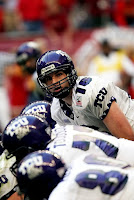
[Quarterback before snap*]

In American football, one of the major differences between experienced and inexperienced as well as effective and ineffective quarterbacks is the ability to audibilize, which means to adjust the play called by the coach as they survey the defense right before the snap. It takes knowledge, judgment and confidence to understand that the given play call will not work and what to do about it.

Likewise, effective technical translators, especially legal experts, know how to correctly take a sentence in one language and render it in another language and culture, making the necessary changes while neither subtracting or adding content. Literal translation of the text can lead to awkward sentences at minimum and fundamental miscommunications at worst.  When translator works properly,  the resulting text may seem noticeably different in terms of sentence structure and even vocabulary but is quite loyal in terms of content.

Simply put, each language has its unique way of expressing itself and framing sentences. Depending on the language combinations, word-for-word translation can lead to simply awful results. The causes for this asymmetry between languages are many and include:

·         Syntax – Word order varies from language to language in terms of placement of subordinate phrases, time expressions, adjectives and even grammatical subjects.

·         Passive/Active – While in certain languages, the passive form is considered more academic and therefore higher level, such as in Hebrew, in other languages it is considered confusing and poor writing. Therefore, in many cases, the translator must change the whole structure, including the form of verb.

·         Punctuation – There are no universal punctuation rules or even rules of what constitutes a sentence. Dostoevsky and lawyers in many languages can get away with whole paragraphs linked with commas and ending after in a period after a half of page (or more). Other languages, notably English, have much more rigid sentence structure and/or stylistic norms, requiring the chopping of sentences in multiple sentences

·         Vocabulary – Languages and cultures vary in terms of terminology development, meaning similar terms may carry more limited or expanded meanings. Moreover, certain terms many not exist in the target language, requiring more creative solutions. Legal, like all technical, translators must understand the exact meaning of a term in both the source and target language.

·         Legalese – Some legal cultures have instituted “plain language” rules intended to render the text intelligible to a greater number of persons. Others view use of the highly specialized phrases as a sign of an erudite writer.

·         Poor source text – The sad fact is that many legal and other technical writers produce poorly written text. While “garbage in, garbage out” may be easier, professional translators try to render the text into proper language.

A truly proficient translator grasps the meaning of the source sentence and creates a clear, well-written equivalent in the target language even if it involves significant changes to the sentence structure and syntax. By contrast, a poor translation may be loyal to the original structure but sounds like a translation. If you wish to judge the result, audibilize it, i.e., read it out loud. It should sound like a native writer wrote it. If so, the legal  translator has properly audiblized the text and is worth hiring again.


* Picture captions help the blind fully access the Internet.

Picture credit

Monday, October 9, 2023

Taxing properties


[house*]

As the old joke goes, the only certainties are death and taxes. Regarding the first, none of us, as far as I know, have any personal experience to speak of but most adults are quite familiar with the second. For example, property owners and sometimes renters have to pay a property tax to their local authority to finance its services. This tax exists almost worldwide but how this tax is calculated varies from country to country. In theory the tax is the product of the base amount and the tax rate. Each country defines the first variable differently and has distinct mechanisms for setting the second as I will show in by comparing the property tax calculation methods in the United States, France and Israel.

In the United States, the base amount is highly variable while the rate is relatively stable. The local authority, usually the city, establishes the rate by vote with the increase in any given year limited by state law, thus protecting the taxpayer from sudden jumps. The city can apply discounts and exemptions for certain areas, building types and income levels at its discretion, On the other hand, the value of a property is based on its current assessed value, i.e., if former neighbors made a killing in selling their houses during a given year, everybody still living in the neighborhood must pay higher taxes as the value has risen according to the latest assessment. The constant increase in property value in California forced people to sell their houses because they could no longer afford the property taxes even if they had paid a modest price for it several decades previously. As a reaction to that, California voters in 1978 passed Proposition 13, which rolled back property taxes, which predictably significantly reduced local services. Thus, US property taxes vary greatly from place to place primarily due to property values.

By contrast, the French taxe fonciére is based on the rental value multiplied by a value local authority. The base amount is 50% of the annual rental value, an amount changing on a yearly basis. The tax rate increase is set by the government but a city can vote a supplementary amount as Paris did this year, raising the tax to 50%, yes fifty percent. Thus, not only do French landowners have to keep on eye on rental values but they also must watch their local councils.

Israel has the arnona, which, typically in Israel, is named after a special tax from centuries ago. The base value for this property tax is the size of the property with the  tax rate set by square meter. One would think that the base amount would remain constant but the local authorities have a nasty tendency to periodically remeasure houses and flats and discover previously unknown meters, such as outside walls and covered garages, thus adding sometimes 10% to the previous measurement. The local authority set the rate with the government determining the minimum and maximum amount. As usual, there is a catch in that a local authority may make an application to the Interior Minister for an exception to these limits. As elsewhere, the local authority can apply this rate uniformly or create partial or complete exemptions, an important matter in a country with a large number of religious institutions of various kinds. Israel property tax bills are relatively stable aside from those re-assessments.

It is almost certain that, if you are a property owner, you complain about property tax bills regardless of which country you live. To be fair, most people are not happy about the level of local services either but that is human, right? Curiously, each country has chosen its particular manner of calculating its pound (or dollar, shekel or euro) of flesh. Is one fairer than the other? That issue taxes my understanding of property.


* Picture captions help the blind fully access the Internet.

Picture credit